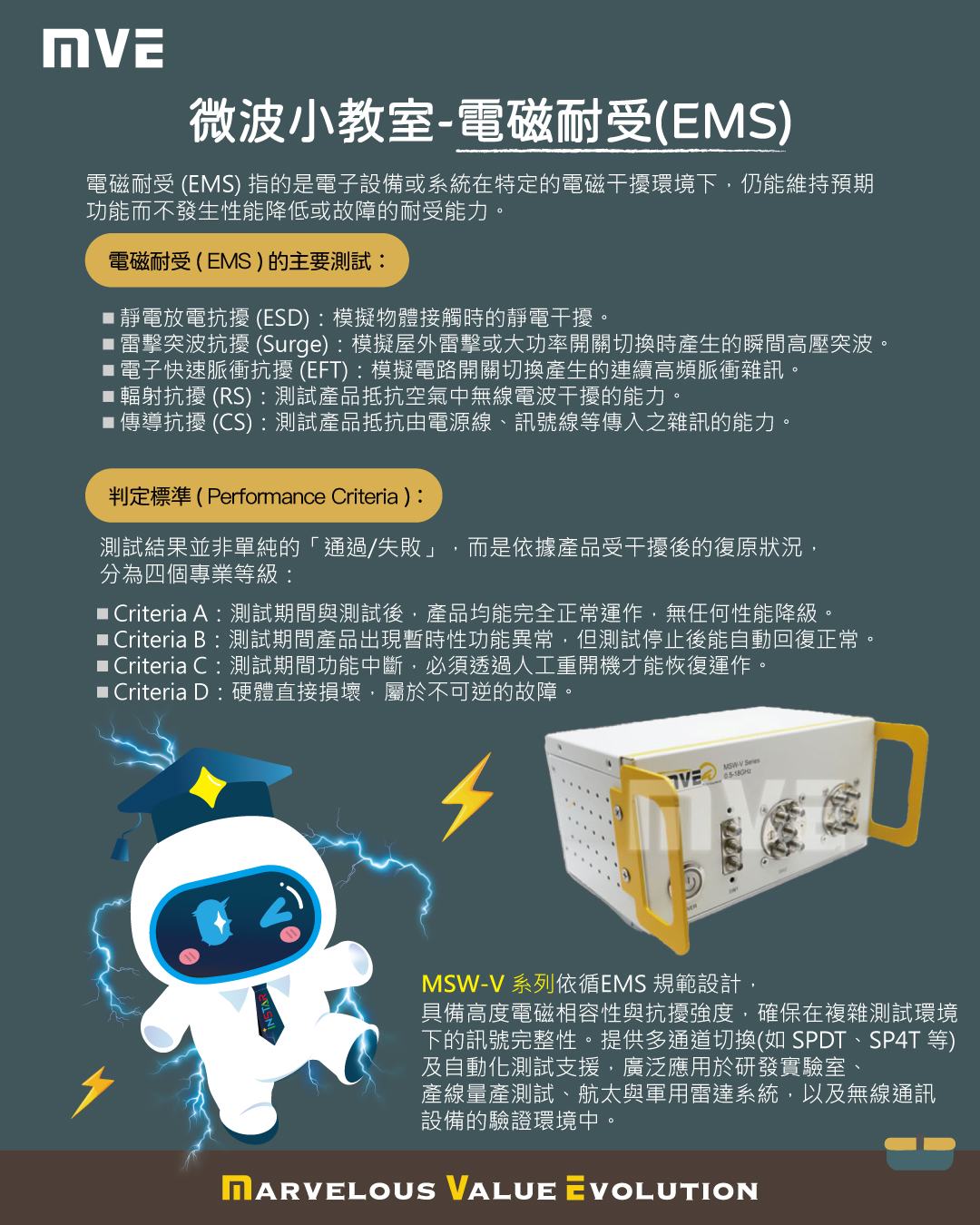
Electromagnetic Susceptibility (EMS)
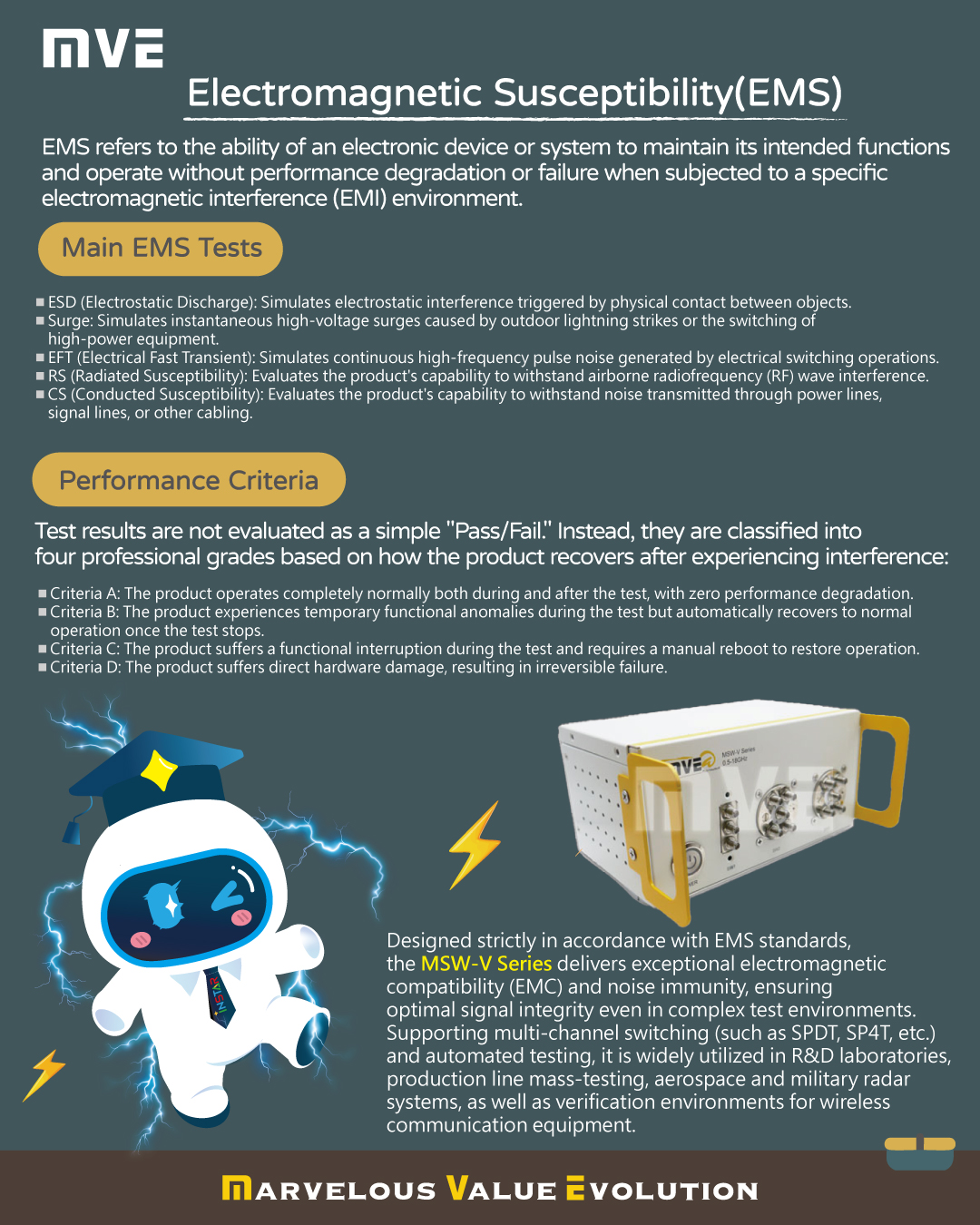
EMS refers to the ability of an electronic device or system to maintain its intended functions and operate without performance degradation or failure when subjected to a specific electromagnetic interference (EMI) environment.
Main EMS Tests
- ESD (Electrostatic Discharge): Simulates electrostatic interference triggered by physical contact between objects.
- Surge: Simulates instantaneous high-voltage surges caused by outdoor lightning strikes or the switching of high-power equipment.
- EFT (Electrical Fast Transient): Simulates continuous high-frequency pulse noise generated by electrical switching operations.
- RS (Radiated Susceptibility): Evaluates the product’s capability to withstand airborne radio frequency (RF) wave interference.
- CS (Conducted Susceptibility): Evaluates the product’s capability to withstand noise transmitted through power lines, signal lines, or other cabling.
Performance Criteria
Test results are not evaluated as a simple “Pass/Fail.” Instead, they are classified into four professional grades based on how the product recovers after experiencing interference:
- Criteria A: The product operates completely normally both during and after the test, with zero performance degradation.
- Criteria B: The product experiences temporary functional anomalies during the test but automatically recovers to normal operation once the test stops.
- Criteria C: The product suffers a functional interruption during the test and requires a manual reboot to restore operation.
- Criteria D: The product suffers direct hardware damage, resulting in irreversible failure.
Designed strictly in accordance with EMS standards, the MSW-V Series delivers exceptional electromagnetic compatibility (EMC) and noise immunity, ensuring optimal signal integrity even in complex test environments.
Supporting multi-channel switching (such as SPDT, SP4T, etc.) and automated testing, it is widely utilized in R&D laboratories, production line mass-testing, aerospace and military radar systems, as well as verification environments for wireless communication equipment.