
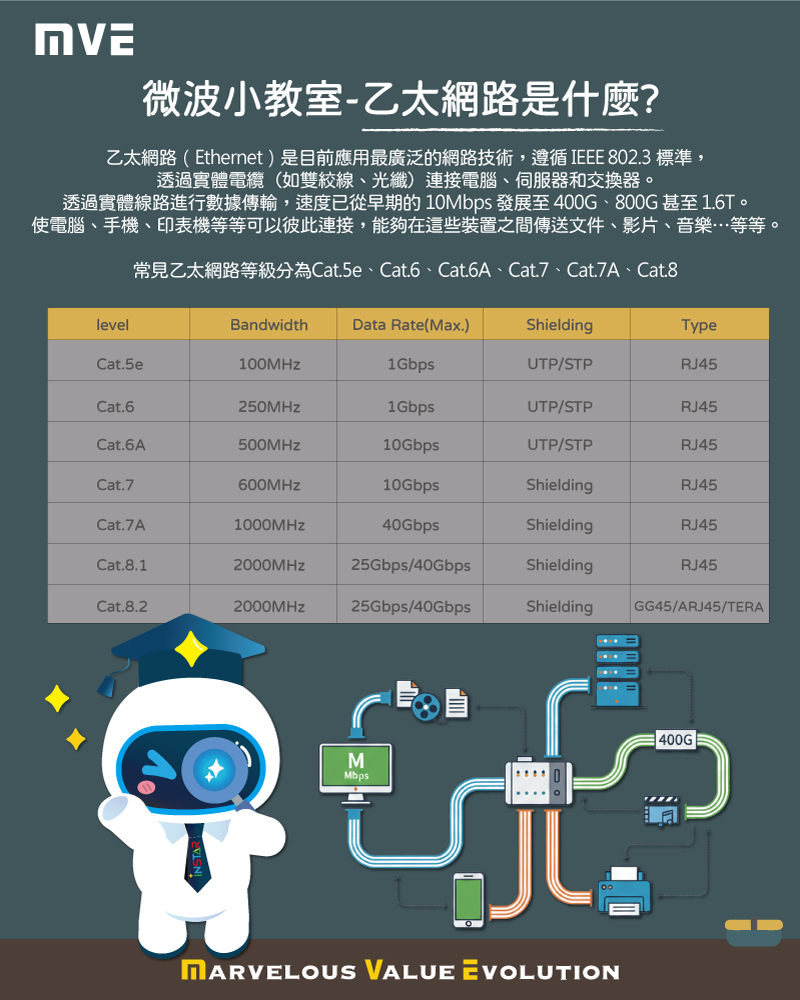
What is Ethernet?
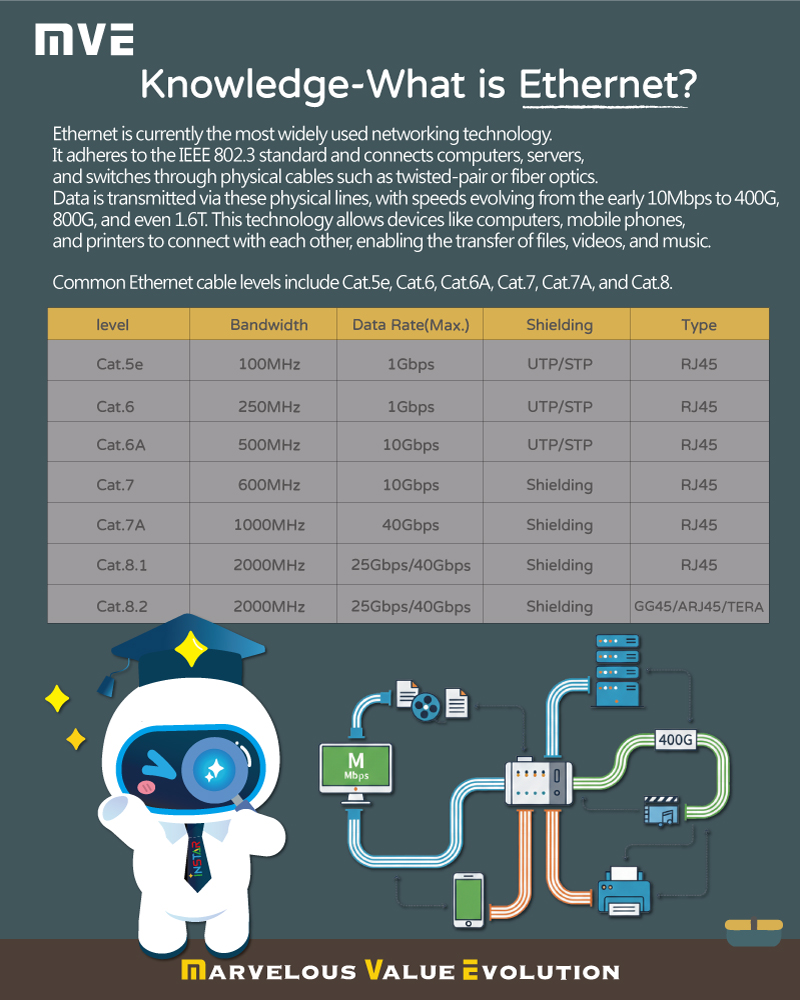
Ethernet is currently the most widely used networking technology. It adheres to the IEEE 802.3 standard and connects computers, servers, and switches through physical cables such as twisted-pair or fiber optics.
Data is transmitted via these physical lines, with speeds evolving from the early 10Mbps to 400G, 800G, and even 1.6T. This technology allows devices like computers, mobile phones, and printers to connect with each other, enabling the transfer of files, videos, and music.
Common Ethernet cable levels include Cat.5e, Cat.6, Cat.6A, Cat.7, Cat.7A, and Cat.8.
| Level | Bandwidth | Data Rate (Max.) | Shielding | Type |
| Cat.5e | 100MHz | 1Gbps | UTP/STP | RJ45 |
| Cat.6 | 250MHz | 1Gbps | UTP/STP | RJ45 |
| Cat.6A | 500MHz | 10Gbps | UTP/STP | RJ45 |
| Cat.7 | 600MHz | 10Gbps | Shielding | RJ45 |
| Cat.7A | 1000MHz | 40Gbps | Shielding | RJ45 |
| Cat.8.1 | 2000MHz | 25Gbps/40Gbps | Shielding | RJ45 |
| Cat.8.2 | 2000MHz | 25Gbps/40Gbps | Shielding | GG45/ARJ45/TERA |
Reference: https://jetharness.com/ethernet-route/