
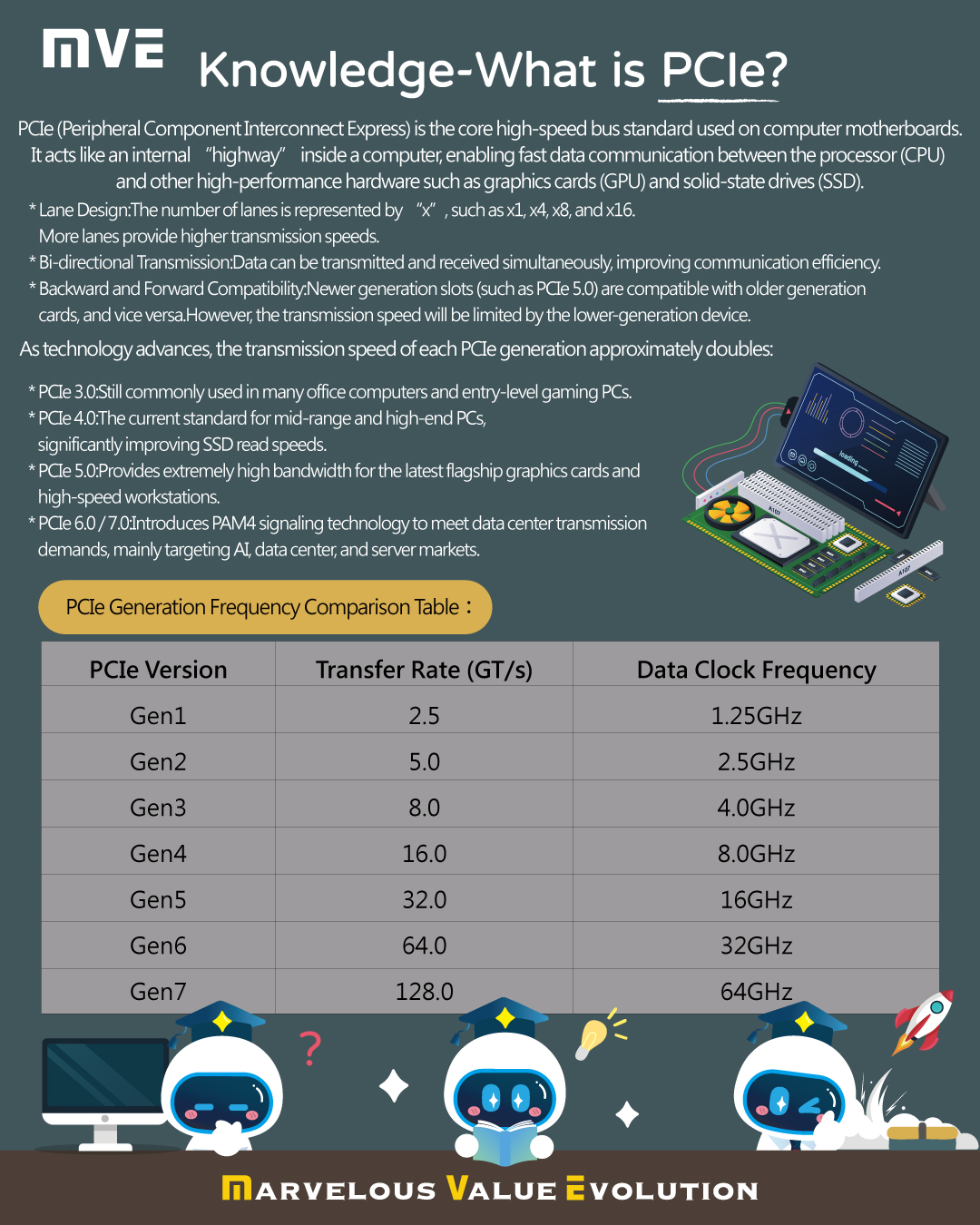
What is PCIe?
PCIe (Peripheral Component Interconnect Express) is the core high-speed bus standard used on computer motherboards.
It acts like an internal “highway” inside a computer, enabling fast data communication between the processor (CPU) and other high-performance hardware such as graphics cards (GPU) and solid-state drives (SSD).
- Lane Design:
The number of lanes is represented by “x”, such as x1, x4, x8, and x16.
More lanes provide higher transmission speeds. - Bi-directional Transmission:
Data can be transmitted and received simultaneously, improving communication efficiency. - Backward and Forward Compatibility:
Newer generation slots (such as PCIe 5.0) are compatible with older generation cards, and vice versa.
However, the transmission speed will be limited by the lower-generation device.
As technology advances, the transmission speed of each PCIe generation approximately doubles:
- PCIe 3.0:
Still commonly used in many office computers and entry-level gaming PCs. - PCIe 4.0:
The current standard for mid-range and high-end PCs, significantly improving SSD read speeds. - PCIe 5.0:
Provides extremely high bandwidth for the latest flagship graphics cards and high-speed workstations. - PCIe 6.0 / 7.0:
Introduces PAM4 signaling technology to meet data center transmission demands, mainly targeting AI, data center, and server markets.
PCIe Generation Frequency Comparison Table
| PCIe Version | Transfer Rate(GT/s) | Data Clock Frequency(Data Clock) |
| Gen1 | 2.5 | 1.25GHz |
| Gen2 | 5.0 | 2.5GHz |
| Gen3 | 8.0 | 4.0GHz |
| Gen4 | 16.0 | 8.0GHz |
| Gen5 | 32.0 | 16GHz |
| Gen6 | 64.0 | 32GHz |
| Gen7 | 128.0 | 64GHz |